
Containerization vs. Virtualization: Choosing the Right Infrastructure Strategy
Modern application deployment requires a deep understanding of infrastructure efficiency. As the demand for scalable and portable software grows, developers and system administrators frequently navigate the choice between traditional virtualization and containerization. While both technologies aim to maximize hardware utilization and improve deployment speeds, their underlying architectures offer distinct advantages for different operational requirements.
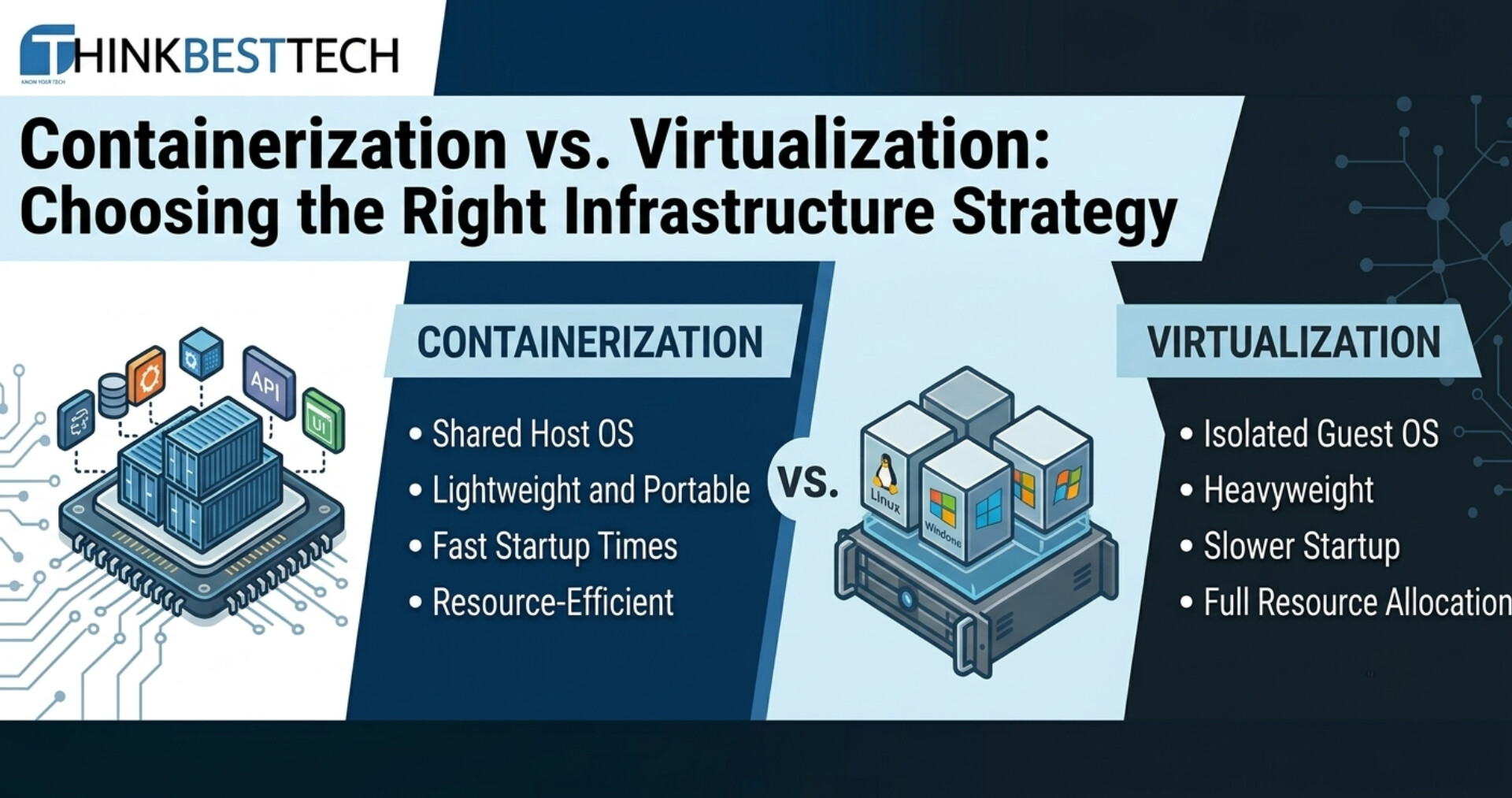
Understanding Virtualization Architecture Virtualization operates by utilizing a hypervisor to create full-scale virtual machines. Each instance includes a complete guest operating system, virtualized hardware drivers, and the necessary binaries to run applications. This approach provides robust isolation, as each environment remains entirely unaware of the host or other instances. It is the preferred choice for legacy applications that require specific OS kernels or scenarios where high-level security segmentation is necessary. However, the overhead of running multiple full operating systems consumes significant memory and processing power, limiting the total density of instances on a single physical host.
The Containerization Paradigm Containerization takes a different path by leveraging the host’s operating system kernel. Containers bundle an application and its dependencies into a lightweight package, sharing the kernel without needing a full guest OS. This design makes them incredibly fast to initiate and highly portable across various environments. Because there is no overhead of a guest OS, developers can deploy significantly more containers than virtual machines on the same hardware. This efficiency is critical for microservices architectures, where complex applications are broken down into smaller, independently deployable modules.
Portability and Consistency in Deployment One of the primary challenges in software engineering is the “it works on my machine” problem. Containerization solves this by ensuring that the application environment remains identical from the developer’s laptop to the production server. By packaging all configuration files and libraries within the container, the software behaves predictably regardless of the underlying host infrastructure. This consistency minimizes deployment errors and accelerates the continuous integration and deployment pipelines, allowing teams to ship features with confidence.
Efficiency in Resource Allocation In environments where resource management is a priority, containers clearly outperform virtual machines. Because they do not need to boot a separate operating system, startup times are measured in milliseconds rather than minutes. This responsiveness allows for highly dynamic scaling. Orchestration tools can automatically scale the number of active containers based on real-time traffic, ensuring that the infrastructure remains perfectly aligned with current demand. This operational model directly translates into cost savings by reducing the total footprint of required hardware and energy consumption.
Selecting the Optimal Strategy The decision between these technologies often depends on the nature of the workload. Virtual machines are the standard for applications that require deep isolation or those that cannot run on the host’s native kernel. Conversely, containerization is the superior choice for modern, cloud-native applications that benefit from rapid scaling and portability. Many organizations adopt a hybrid approach, using virtual machines to host the container runtime environments, thereby combining the security of hardware isolation with the operational agility provided by container orchestration. Selecting the strategy that aligns with your specific scalability goals is the foundation of building a resilient and cost-effective digital ecosystem.