
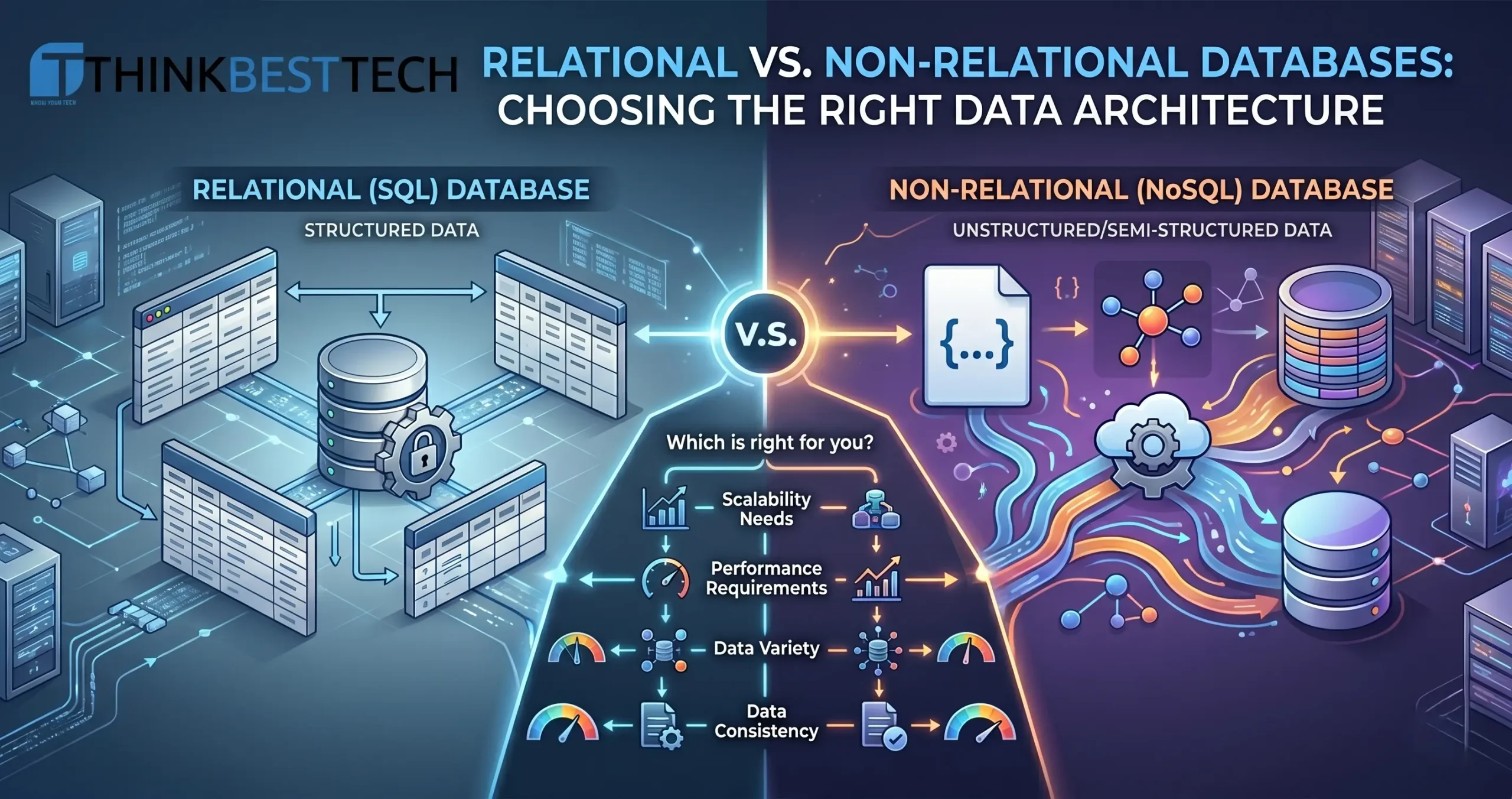
Relational vs. Non-Relational Databases: Choosing the Right Data Architecture
The foundation of any robust application lies in how it organizes, stores, and retrieves information. As data complexity increases, the choice between relational and non-relational database models becomes a pivotal architectural decision. Understanding the technical distinctions between these systems allows engineers to build scalable software that meets the specific demands of their workload, whether dealing with structured transactions or massive amounts of unstructured content.
The Mechanics of Relational Databases (RDBMS) Relational databases operate on a structured schema where information is stored in tables consisting of rows and columns. This model relies on Structured Query Language (SQL) to define and manipulate data. Because the relationships between different tables are strictly enforced through keys, this system is ideal for applications where data consistency and accuracy are non-negotiable. Financial platforms and inventory management systems rely on these architectures to prevent anomalies and ensure that every transaction adheres to predefined business logic. The rigid nature of the schema acts as a safeguard against data corruption.
The Flexibility of Non-Relational Databases (NoSQL) Non-relational databases, often referred to as NoSQL, offer a flexible approach to data management. Unlike their rigid counterparts, these systems can handle unstructured or semi-structured data such as documents, graphs, or key-value pairs. This flexibility allows developers to iterate quickly on their application design without needing to modify the entire database schema whenever requirements change. Systems processing social media feeds, real-time analytics, or content management platforms benefit from the high write-speeds and horizontal scalability inherent in this design, as the architecture is built to distribute data across multiple servers easily.
Scalability and Performance Considerations A primary distinction lies in how these systems scale. Relational models typically scale vertically, which involves increasing the power of the server, such as adding more RAM or faster processing units. While effective, this approach hits a physical ceiling. In contrast, non-relational models are designed for horizontal scaling, where additional nodes are added to a distributed network to share the computational burden. This capability makes them the primary choice for global applications that experience massive surges in traffic, ensuring that performance remains stable even as the volume of information grows exponentially.
Transaction Integrity and CAP Theorem The CAP theorem—consisting of Consistency, Availability, and Partition Tolerance—serves as a framework for understanding the trade-offs in database design. Relational systems prioritize strong consistency, ensuring that every read request returns the most recent write. However, this focus on consistency can lead to latency during partition failures. Non-relational systems often prioritize availability and partition tolerance, allowing for faster response times in distributed environments. Choosing the appropriate balance depends entirely on the operational requirements of the software. An application where data loss is unacceptable requires strong consistency, whereas an application that must remain online at all costs might favor availability.
Strategic Implementation Guidelines Selecting the correct infrastructure depends on the nature of the data lifecycle. For projects involving complex queries, multi-row transactions, and a fixed structure, relational systems remain the industry standard due to their maturity and reliability. Conversely, projects requiring rapid development cycles, varied data formats, and the ability to handle large-scale horizontal growth are better served by non-relational models. Many modern architectures even employ a polyglot persistence strategy, utilizing multiple database types within the same application to leverage the unique strengths of each system for different functional components.