
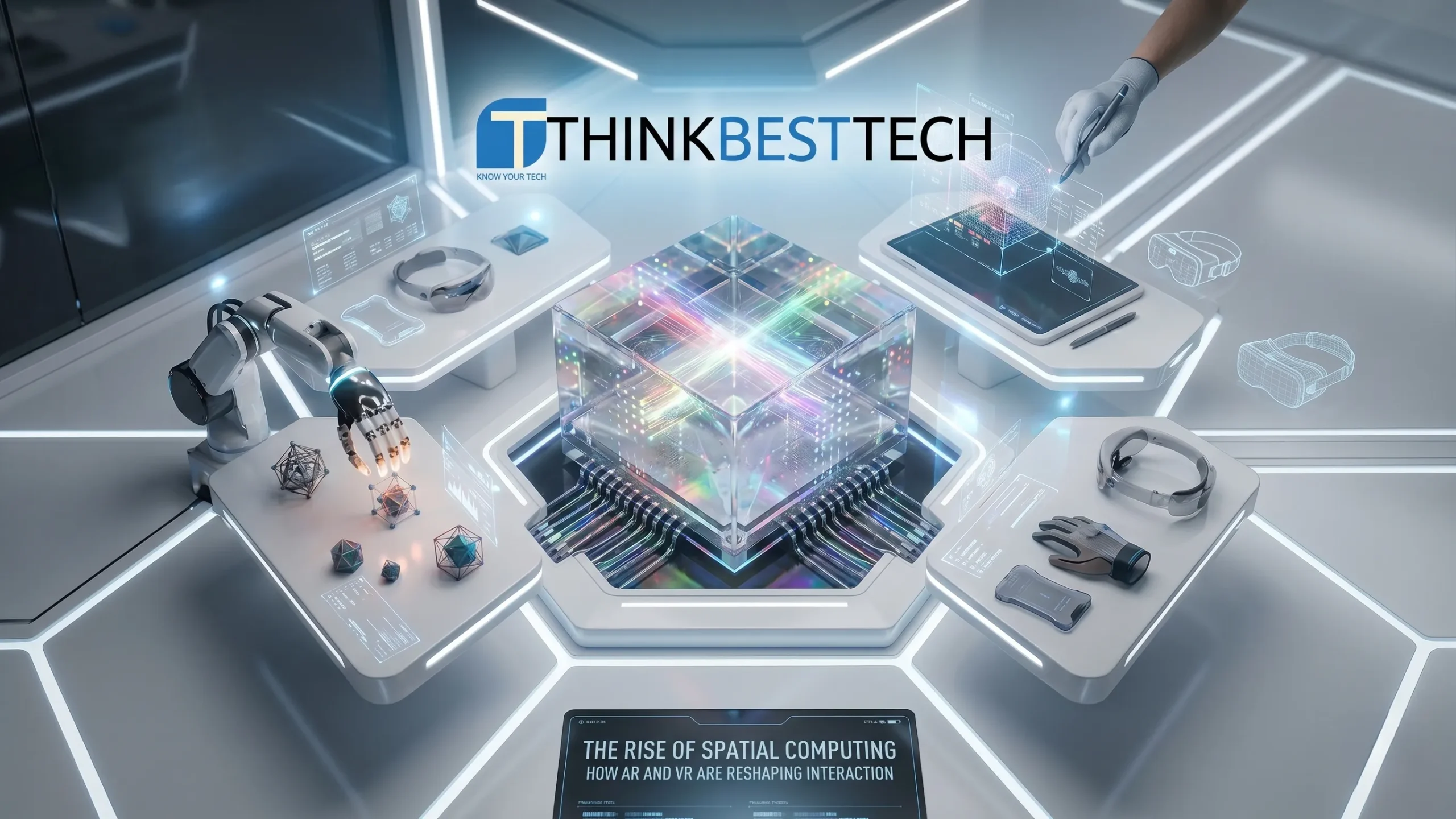
The Rise of Spatial Computing: How AR and VR are Reshaping Interaction
The integration of digital elements into our physical surroundings represents a monumental shift in human-computer interaction. Spatial computing has moved well beyond the realm of gaming and entertainment, establishing itself as a transformative technology for productivity, communication, and digital design. By utilizing augmented reality (AR) and virtual reality (VR), developers are breaking free from the constraints of flat, two-dimensional screens to create immersive environments that respond directly to natural physical movements.
Redefining User Interfaces and Interaction For decades, navigating the digital world required peripherals like mice and keyboards to interact with flat interfaces. Spatial technology changes this paradigm completely by turning the user’s physical environment into the operating system itself. Hand tracking, eye movement sensors, and voice commands replace traditional inputs, allowing individuals to manipulate digital objects as if they were physical items in the real world. This evolution demands a complete rethinking of UI/UX principles, pushing designers to construct intuitive three-dimensional spaces where information is layered dynamically over the user’s field of vision.
Enhancing Professional Workflows and Prototyping The impact of this immersive technology on professional workflows is profound, particularly for visual creators and engineers. Instead of evaluating complex 3D models on a flat monitor, designers can now project life-sized prototypes directly into their living room or studio. This allows for an immediate, realistic understanding of scale, proportion, and spatial relationships. Teams collaborating from different continents can inhabit the exact same virtual workspace, examining and modifying a holographic model in real-time. This capability drastically reduces the time and cost associated with physical prototyping and iterative design cycles.
The Role of Artificial Intelligence in Spatial Mapping To render digital objects realistically within a physical space, the hardware must perfectly understand its surroundings. This is where advanced artificial intelligence and machine learning algorithms become essential. Computer vision technology continuously scans the room, identifying floors, walls, and physical obstacles to ensure that holographic elements interact naturally with the real world. If a virtual object moves across the floor, the AI ensures it reacts to physical furniture rather than passing through it. This real-time environmental understanding is critical for maintaining a seamless and believable experience.
Revolutionizing Retail and E-commerce Experiences The retail sector is experiencing a massive disruption thanks to augmented overlays. Consumers are no longer restricted to viewing static images or standard video clips of products. Spatial applications allow shoppers to project furniture into their homes to verify dimensions or virtually try on apparel using highly accurate body tracking capabilities. This level of interactive visualization significantly boosts buyer confidence and reduces return rates, fundamentally altering the logistics and customer engagement strategies of modern e-commerce platforms.
Overcoming Hardware and Infrastructure Challenges While the software capabilities are expanding rapidly, widespread adoption heavily depends on hardware advancements. Early headsets were often bulky, tethered to high-end computers, and prone to causing motion sickness. The industry is now fiercely focused on standalone, lightweight wearables that process complex spatial mapping natively. Achieving this requires incredibly efficient mobile processors and low-latency network connections. As ambient computing becomes more seamlessly integrated into everyday eyewear, the line between the physical and digital domains will continue to blur, making immersive technology a standard utility rather than a niche novelty.